
By Laura Davis
TL;DR: In-store media measurement has a proof problem. Most in-store media networks can prove an ad played. Few can prove anyone saw it, and almost none can prove it sold anything. IAB standards already describe how to count impressions and how to test for sales lift. Few networks run that test. The fix is running it with comparable test and control stores, not buying a better sensor.
Retailers keep installing screens. Brands keep asking one question: did it work? Most of the time, nobody can say.
In-venue media doesn’t have a measurement shortage. It has a methodology shortage.
That gap costs real money. At the DSF Takeover during Digital Signage Week in New York, one speaker put it at 99% of retail media budget going to web channels, because web feels easy to target and easy to measure. In-store media gets whatever is left over. eMarketer puts digital in-store at under 1% of the US retail media pool, though it expects that slice to grow about 33% in 2026. When the base is that small, a big percentage still isn’t much money.
"We fund well what we measure well," as P&G puts it. In-store won’t get funded well until it gets measured well.
It helps to see where in-store sits. Jordan Fraser of Vistar Media and Aidan Rush of T-Mobile Advertising Solutions presented at the DSF Takeover, and one slide (our recap is on LinkedIn) broke retail media into four channels. On-site is a retailer’s own website or app. Off-site uses a retailer’s first-party data to reach shoppers on other sites and platforms. In-store covers screens, endcaps, and audio inside the physical store. Near-store covers out-of-home screens and location-targeted media that reach shoppers on the way to a store. Their bigger point was that the channels work together, and that in-store can contribute more than impressions. What a retailer learns inside its stores can inform campaigns across the whole ecosystem and help make the case for more investment.
When brands ask whether the screens worked, too many networks answer with a report showing the ad played. A play report tells a brand the screen was on. Whether anyone noticed, or bought something because of it, is a different question, and most networks can’t answer it.
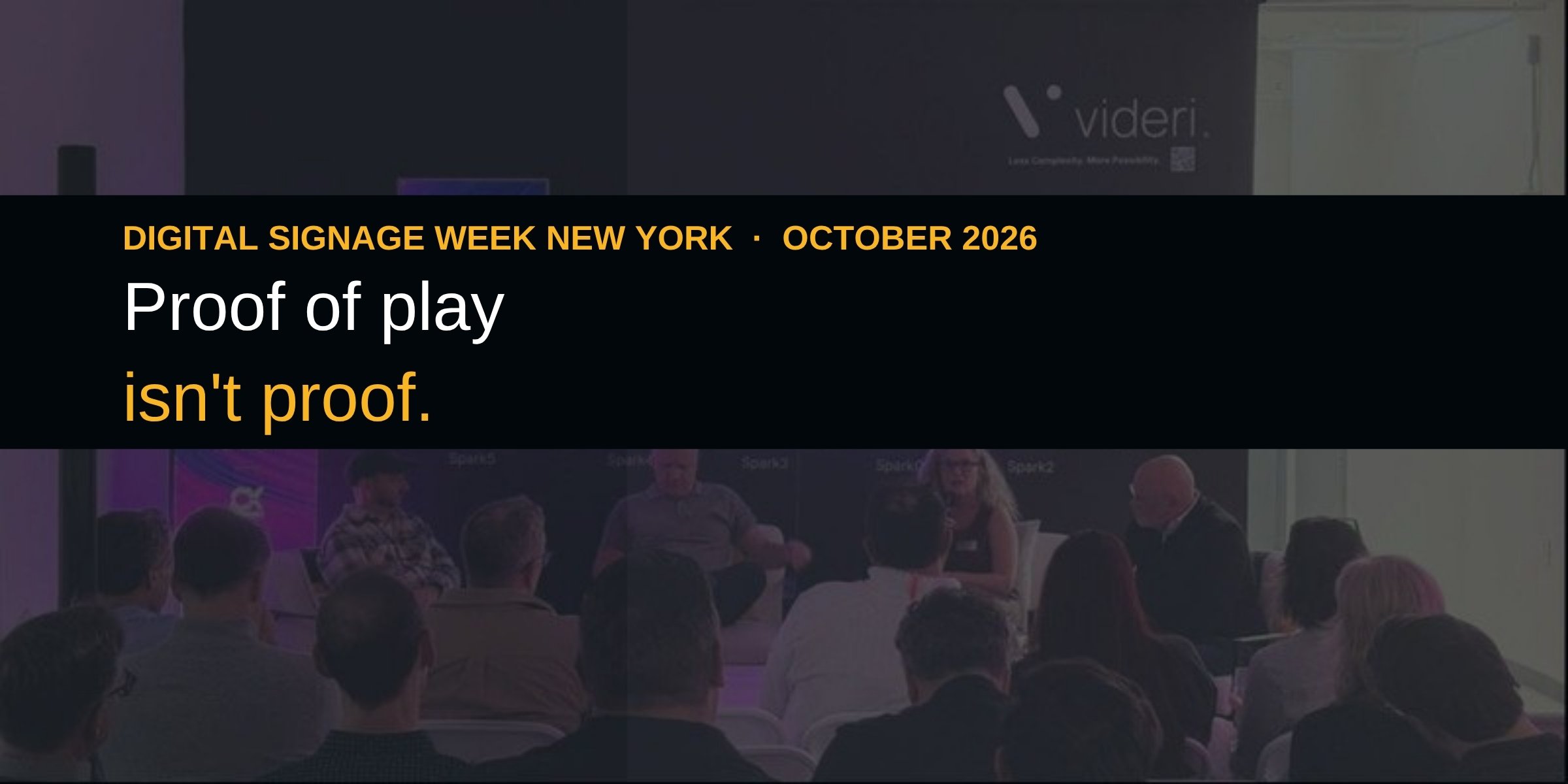
I sat on a measurement panel at the Digital Sign Federation Open House, which Videri co-hosted with CollectiveX that same week, and came away with one view. (Our five takeaways from the panel are posted separately.) The category has plenty of tools for measuring in-store media. What it lacks is agreement on method: what to prove first, what to prove next, and how to run a fair test.
This is a field report, so there’s no new Videri data in it. It’s what I heard in the room and what we’ve picked up working with retailers.
In-store media measurement has four proofs: played (the ad ran, and you can show where and when), seen (someone was near the screen, and you can say roughly how many and for how long), moved (they did something, like stop, look closer, or ask a question), and sold (stores running the ad outsold similar stores that weren’t).
Most networks I know can answer the first one. In the same session, Vistar’s Jordan Fraser described plenty of implementations as “relatively basic media networks,” and I’d say that’s about right. They have proof of play and not much past it.
IAB and IAB Europe have both published standards for in-store retail media, which helps. They treat opportunity to see as the stand-in for a viewable impression, and they set ad plays and gross impressions as the minimum a network should report. Buyers and sellers finally have the same way to count.
The standards also go past counting. They list test versus control as a way to tie an ad to sales. The catch is that few networks actually run the test, and there’s still no standard baseline to measure against. On the panel I said that until we have standard baseline metrics for out-of-home and in-venue, it’s going to be a lot harder to crack the nut. It’s also a big reason in-venue is hard to buy programmatically, since nobody can price against a baseline that doesn’t exist yet.
The pricing tells the same story. The historically low CPMs for in-store show how poorly the industry has valued in-venue media. We’ve been selling proximity to purchase at bargain-basement prices, and the way out is to stop selling impressions and start showing business impact.
Most of the arguments I hear are about which sensor or which platform to buy. I’d spend that energy on the test design.
ROAS tells you a brand spent $100 and sold $400. It doesn’t tell you what they would have sold anyway. For that you need a test group and a control group: pick comparable stores, run the ad in some of them, and compare. Splits vary. Some go 50/50 and some go 90/10. T-Mobile Advertising Solutions has been testing this way for about three years.
The easiest way to wreck a test is to rig the split without meaning to. If the ads end up in your wealthiest stores, you’ve mostly measured wealthy stores.
We’ve learned a few things the slow way. Pairing each test store with about 20 benchmark stores kept our comparisons clean. If you don’t take associates out of the sensor data, you end up with a dog’s breakfast. And what people say in a survey often differs from what they do in the aisle, so I trust behavior over answers.
The ad log is the starting point, since it records what played, where, and when. One way to build on it is device ID passback. You draw a circle around where the ad played and capture the anonymized devices that were nearby. It won’t match everyone, but it gives you a group you can follow, and you can use that group to measure results, tie them to loyalty data, or retarget.
Joining sensors to point-of-sale data used to mean a $100,000 custom project, with a camera, a door counter, a beacon, and POS wired into one dashboard by hand. APIs have cut that down a lot. Still, no single product does the whole job, so I’d be skeptical of any pitch that says otherwise. And if privacy is a concern, which it should be, look for analytics that run anonymously on the device itself, so no one’s image or identity leaves the room.
A lot of the friction has nothing to do with technology. Trade marketing teams care about reach and ad tech teams care about outcomes, so two groups spending the same dollars keep score differently. Creative, content, and measurement usually sit on separate teams too. Then there’s staffing: Skai and Stratably’s 2026 survey found that 14% of brand and agency marketers don’t measure incrementality at all, and more than half named limited analytics and data science resources as their biggest barrier.
One panelist described retailers handing insights to brands for free and creating “a bit of an addiction.” That works until a brand’s budget gets cut the next quarter. Without outcome data, the retailer has to start the sales story over from scratch, and spending that can’t show a result is the first thing to go.
If you run a network, ask these of yourself. If you’re an integrator, bring them to your customer’s first meeting.
1. What outcome does this retailer weight most? One retailer on the panel ranks other metrics above in-store sales because it drop-ships much of what it sells.
2. Can we get the ad log, and for how long can we keep it?
3. Can we run a control group, and are the stores comparable?
4. Who owns the data and the proof?
5. Who in the building can read the results?
Videri builds the screens and the platform that keep proof of play accurate and ready to be joined to other data. That covers the first proof cold. For the fourth, we work with partners who design the test.
Here’s what it looks like in the field. A global beverage brand piloted Videri Canvases in bars across 10 European countries. Within 90 days, beverage sales at those bars were up more than 20%, and the brand now runs tens of thousands of Canvases in more than 80 countries. That was a before-and-after read, not a controlled test. Which is the point: the next brand will ask what would have happened anyway, and a matched control is how you answer it.
If you want to know which of the four proofs your network can back up today, we'd be delighted to talk it through.
The industry needs to stop selling what’s possible and start proving what works. Prove the first two. Then design the test for the fourth.
The full 16-page field report is free.
It’s the practice of proving what an ad on an in-store screen did. It runs from basic proof of play, to counting people near the screen, to tracking what they did, to comparing sales in stores with and without the ad.
No. Proof of play shows the ad ran, and when and where. It doesn’t show that anyone saw it or that it changed what they bought.
IAB and IAB Europe treat opportunity to see as the stand-in for a viewable impression and set ad plays and gross impressions as the minimum networks report. They also list test versus control as a way to tie in-store ads to sales. What they don’t set is a standard baseline, and few networks run the test.
Run a test with a control group. Pick comparable stores, run the ad in one group only, often split 50/50 or 90/10, and compare sales between the groups. Don’t choose the test stores in a way that favors them, such as only picking affluent locations.
Ask what outcome the retailer cares about, whether you can get and keep the ad log, whether you can run a control group in comparable stores, who owns the data and the proof, and who can read the results.


